

Langley Alloys specialises in high-strength copper alloys, including our own Hiduron® 130 (high-strength) and Hiduron® 191 (medium-strength) copper-nickel, and Hidurel® 5, supplied as bar from stock for marine, subsea and defence use.
Hiduron® and Hidurel® are Langley Alloys brands.
What are copper alloys?
Copper alloys are copper-based metals engineered for a specific balance of strength, seawater corrosion resistance and, in marine service, resistance to biofouling and galling. Langley makes its own high-strength grades rather than standard bronzes: Hidurel® 5, a precipitation-hardening copper-nickel-silicon alloy (UNS C64700), and Hiduron® 130 and Hiduron® 191, high-strength cupronickels strengthened with aluminium.
They combine high strength, comparable to duplex stainless in the case of Hiduron® 191, with excellent resistance to seawater and crevice corrosion, anti-galling behaviour, freedom from hydrogen embrittlement and very low magnetic permeability. That suits subsea couplings and connectors, pump and propeller shafts, valve trim, bearings and naval hardware, where standard copper alloys are too weak and stainless too prone to seizing or magnetic signature.
Grades
Hidurel® 5
UNS C64700Hidurel® 5 is a high-strength copper-silicon-nickel alloy combining seawater corrosion resistance with good machinability.
Hiduron® 130
Hidurax SpecialHiduron® 130 is a high-strength cupronickel combining seawater corrosion resistance with low magnetic permeability.
Hiduron® 191
DEF STAN 02-835Hiduron® 191 is a high-strength copper-nickel alloy with outstanding seawater and biofouling resistance for marine service.
How the grades compare
At a glance: UNS number, defining property, typical applications and the forms we stock for each copper alloys grade.
| Grade | UNS | Key property | Typical applications | Forms stocked |
|---|---|---|---|---|
| Hidurel® 5 | C64700 | Precipitation-hardening Cu-Ni-Si; high strength with high electrical and thermal conductivity | Naval shafts and bolting, bearings, welding electrodes, moulding dies | Bar |
| Hiduron® 130 | Hidurax Special | One of the highest-strength copper alloys; aluminium-strengthened cupronickel with anti-galling | Naval and marine shafts, seals, oil & gas valve and pump components | Bar |
| Hiduron® 191 | DEF STAN 02-835, NES 835 | Precipitation-hardened cupronickel; strength of duplex with cupronickel corrosion and anti-fouling | Naval fasteners, submarine components, subsea bolting, pump shafts | Bar |
Why specify high-strength copper alloys?
Hidurel® and Hiduron® are precipitation-hardened copper-nickel alloys that go far beyond standard cupronickels and aluminium bronzes:
- High strength combined with excellent seawater and marine corrosion resistance
- Resistance to hydrogen embrittlement and stress corrosion cracking
- Excellent anti-galling, bearing and wear properties, particularly against steels
- Very low magnetic permeability, suited to naval and sensor applications
- No loss of impact strength down to -196°C for cryogenic and deep-sea service
- Strength comparable to 22% chromium duplex stainless steel (Hiduron® 191)
Material tools
Seawater velocity limits
Seawater Velocity Limits
Check a seawater flow velocity against the maximum design velocity for copper and copper-nickel alloys, to avoid impingement (erosion-corrosion) attack. Enter a velocity directly, or work it out from flow rate and pipe bore. Design guidance from CDA / Nickel Institute and BSMA 18.
| Alloy | UNS | Design velocity | BSMA 18 pipe |
|---|
Design guidance, not a guarantee. Maximum velocities avoid impingement/erosion-corrosion in clean seawater. Limits reduce at small bores (BSMA 18 pipe values apply above ~100 mm bore, reduced below). Local turbulence at bends and fittings, partial blockage, entrained air or sand, and higher temperature all lower the safe velocity. Confirm against the project specification and the product's own data.
Hardness converter
Hardness Converter
Convert between Brinell, Vickers, Rockwell C and Rockwell B, with the approximate tensile strength. Values follow the ASTM A370 conversion tables for non-austenitic steels; nothing is extrapolated beyond the tabulated range.
Conversions are approximate and material-dependent. Based on ASTM A370 hardness conversion tables for non-austenitic steels (equivalent to ASTM E140). Brinell is not reported above about HRC 65, and each Rockwell scale is only valid over its own range - values outside it show as out of range, never extrapolated. Use as a guide, not a substitute for direct measurement on the actual material.
Applications
How do you machine copper-nickel alloys?
The Hidurel® and Hiduron® alloys are high-strength but machine more freely than nickel or duplex grades. Use sharp tooling with firm feeds and adequate coolant; their good anti-galling and bearing characteristics generally give clean finishes.
As precipitation-hardened grades they are normally supplied ready-aged, so no post-machining heat treatment is required.
Technical resources
Common questions
What are cupronickels?
Cupronickels are copper-nickel alloys prized for excellent resistance to seawater corrosion and biofouling. Langley's Hiduron® grades add aluminium and other elements to give far higher strength than standard cupronickels.
What do Hidurel® and Hiduron® mean?
Hidurel® and Hiduron® are trademarks of Langley Alloys for our high-strength, precipitation-hardened copper-nickel alloys, developed for demanding marine, naval and oil and gas applications.
Why is nickel added to copper?
Adding nickel to copper improves strength and, crucially, corrosion and erosion resistance in seawater, producing the cupronickel family used widely in marine engineering.
Are cupronickels magnetic?
Cupronickels have very low magnetic permeability. With Hidurel® 5 below 1.001, they are well suited to naval and sensor applications where a low magnetic signature matters.
How does Hiduron® 191 compare with nickel aluminium bronze?
Hiduron® 191 offers superior corrosion resistance and greater strength and toughness than nickel aluminium bronzes, with strength comparable to 22% chromium duplex stainless steel.
Are these alloys resistant to hydrogen embrittlement?
Yes. Despite their high strength, Hidurel® 5 and the Hiduron® grades resist hydrogen embrittlement, which is why they are chosen for subsea bolting and high-strength fasteners.
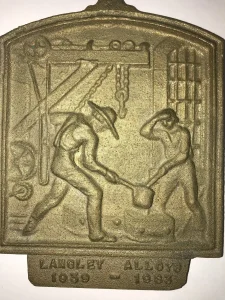
History of Hidurel® and Hiduron®
Langley Alloys' copper alloys are part of the company's own story. Langley grew out of the copper alloys work of High Duty Alloys, a pioneer of high-performance materials for aerospace, and took its name from its site at Langley in west London. Its speciality from the outset was copper alloys engineered to go far beyond ordinary copper: Hidurel® 5, a copper-nickel-silicon alloy, was used for a major bearing in the Rolls-Royce Merlin engine that powered the Spitfire.
Read more Read less
These are high-strength copper alloys made to do what unalloyed copper cannot. They keep the seawater corrosion resistance, anti-fouling and anti-galling qualities that make cupronickels so valued at sea, while reaching strengths that rival duplex stainless steel. Non-magnetic, non-sparking and resistant to hydrogen embrittlement, they became a natural choice for naval and defence engineering, and more recently for subsea oil and gas, where connectors, shafts and fasteners must last for decades on the seabed.
The family divides neatly. Hidurel® 5 is the original copper-nickel-silicon alloy, valued for bearings and its balance of strength and conductivity. The Hiduron® grades are precipitation-hardened cupronickels: Hiduron® 130, Langley's highest-strength copper alloy, developed for naval service, and Hiduron® 191, developed later for greater impact toughness, which meets the British defence specifications DEF STAN 02-835 and NES 835.
The corrosion resistance of a cupronickel with the strength of duplex stainless steel, engineered by Langley.
Request a quote
Tell us the grade, form and sizes.
Fast quotes from UK and US stock - bar, plate and pipe, cut and certified to spec.