

Langley Alloys is a specialist duplex supplier, stocking Alloy 2205 as bar and plate, with tube and pipe available on enquiry, cut to size from our UK (the Midlands) and USA (Conroe, Texas) sites.
We supply worldwide, with EN 10204 3.1 certification as standard and 3.2 third-party witness inspection available.
What is duplex stainless steel?
Duplex stainless steel has a two-phase microstructure of roughly equal austenite and ferrite, giving about twice the strength of standard austenitic grades such as 316, with good resistance to chloride pitting and stress-corrosion cracking. The workhorse grade is 2205 (UNS S31803/S32205, 1.4462): around 22% chromium with molybdenum and nitrogen, and a pitting resistance equivalent (PREN) in the mid-30s.
It sits between standard stainless and super duplex (PREN 40 or more) on both cost and corrosion resistance.
Grades
Alloy 2205
UNS S32205Alloy 2205 is a 22% chromium duplex stainless steel, stronger and more corrosion-resistant than austenitic grades like 316L.
Why specify duplex stainless steel?
Duplex stainless steels blend the strength of ferritic and the toughness of austenitic grades. Alloy 2205 offers:
- Higher strength than standard austenitic stainless steels, allowing thinner sections and lower weight
- Better corrosion resistance than Alloy 316L or 317L in most corrosive media, with a PREN of 33-34
- Good resistance to pitting and crevice corrosion in seawater and chloride environments
- High resistance to chloride stress corrosion cracking
- Well suited to sour service containing chlorides and hydrogen sulphide
- Lower thermal expansion and higher thermal conductivity than austenitic grades
Material tools
PREN calculator
PREN = %Cr + 3.3 × (%Mo + 0.5 × %W) + 16 × %N. Guidance only; always confirm against the grade's datasheet before specifying.
Pitting & crevice resistance
Pitting & Crevice Resistance
Rank alloys by PREN and get an indicative pitting temperature for a chloride service. Pick a grade and a service temperature to see whether it has margin against pitting, or compare the range in the table below. A first-pass screen for chloride and seawater service.
| Grade | UNS | PREN | Indicative CPT | Relative pitting resistance |
|---|
Indicative screen, not a certified result. PREN ranks pitting resistance; the pitting temperature here is estimated from PREN (CPT ≈ 2.5 × PREN - 50), consistent with Langley's "PREN >40, CPT exceeding 50°C" for super duplex. Real critical pitting/crevice temperature depends on test method, product form, surface finish and service chemistry. Crevice corrosion starts well below the pitting temperature - allow a margin at gaskets, deposits and flange faces. Use certified data for design.
Sour-service screen (NACE MR0175)
Sour-Service Screen
Work out whether a service is sour from the H2S partial pressure, and see each alloy's NACE MR0175 / ISO 15156 status and hardness limit. A first-pass screen for oil & gas material selection - the full environmental envelope for a grade is set in ISO 15156-3 Annex A.
Candidate grade
| Grade | Family | NACE status | Hardness limit |
|---|
First-pass screen only. This shows whether the service is sour (from H2S partial pressure) and each material group's NACE MR0175 hardness limit and general suitability. It does not reproduce the full environmental windows (maximum H2S partial pressure, temperature, chloride, in-situ pH per grade) - those are in ISO 15156-3 Annex A and must be checked there for the specific grade, product form and condition. Qualification also depends on heat treatment, cold work and welding.
Applications
How do you machine duplex stainless steel?
Duplex stainless steels are stronger and more work-hardening than standard austenitic grades, so they need a slightly more robust approach. Use rigid set-ups and sharp, positive-rake carbide tooling, keep the cut continuously engaged to avoid work-hardening the surface, and run moderate speeds with a firm, constant feed and flood coolant.
Machinability-enhanced (Sanmac®) versions are available where higher metal-removal rates are required.
Technical resources
Common questions
What are duplex stainless steels?
Duplex stainless steels combine roughly equal amounts of austenite and ferrite, giving higher strength than standard austenitic grades together with good corrosion resistance. Alloy 2205, based on 22% chromium, is the most widely used duplex grade.
Is Alloy 2205 better than 316L?
For most demanding service, yes. Alloy 2205 is roughly twice as strong as 316L and, with a PREN of 33-34, gives better pitting and crevice corrosion resistance in most media, particularly chloride and sour environments.
What is the difference between S31803 and S32205?
Both designate Alloy 2205. S32205 (F60) is a tightened, higher-alloy version of the original S31803 (F51), with higher guaranteed minimum chromium, molybdenum and nitrogen for consistent corrosion performance. Modern 2205 is normally supplied to meet both.
What is the difference between duplex and super duplex?
Super duplex is based on around 25% chromium versus 22% for standard duplex, which raises the PREN from around 34 to above 40 for superior pitting corrosion resistance.
Is duplex stainless steel magnetic?
Yes. Because duplex contains ferrite it is magnetic, unlike fully austenitic stainless steels such as 316.
What is PREN?
The Pitting Resistance Equivalent Number estimates resistance to pitting corrosion (%Cr + 3.3 × %Mo + 16 × %N). Alloy 2205 has a PREN of 33-34, versus above 40 for super duplex grades.
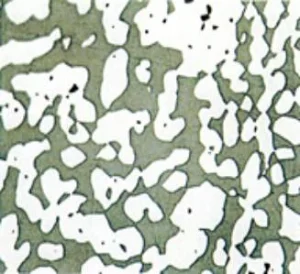
History of duplex stainless steel
Duplex stainless steel began in Sweden. In 1929 the Avesta ironworks produced the first commercial duplex grade, 453E, a 25% chromium, 5% nickel steel whose mixed structure of ferrite and austenite resisted the intergranular corrosion that troubled the ferritic grades of the day. A companion grade, 453S, followed soon after.
Read more Read less
The second landmark was an accident. In 1933, at the J. Holtzer works in France, an error while melting an 18% chromium, 9% nickel stainless produced a steel far higher in chromium and ferrite than intended. Rather than a spoiled heat, it proved to have unexpectedly good corrosion resistance, and the accidental duplex became a subject of serious study.
Early duplex was strong and corrosion-resistant but hard to weld, as the heat-affected zone turned largely ferritic and lost toughness. The modern grades solved this in the 1970s, when AOD refining allowed precise nitrogen additions that restore austenite in the weld zone and lift strength and pitting resistance together. Alloy 2205, a 22% chromium duplex, became the workhorse of this generation and remains the most widely specified duplex stainless steel, with higher-alloyed super duplex grades following in the 1980s for the most demanding offshore service.
Twice the strength of 316L with better corrosion resistance - Alloy 2205 is the duplex workhorse for chloride and sour service.
Request a quote
Tell us the grade, form and sizes.
Fast quotes from UK and US stock - bar, plate and pipe, cut and certified to spec.