

Langley supplies far more than bar and plate. Through long-standing partnerships with leading foundries and forges, we source castings and forgings across a wide range of copper, copper-nickel and high-performance alloys, including our own Hiduron® and Hidurel® grades.
We combine them with our machining, inspection and stockholding to deliver complete components to your specification, from a single point of supply.
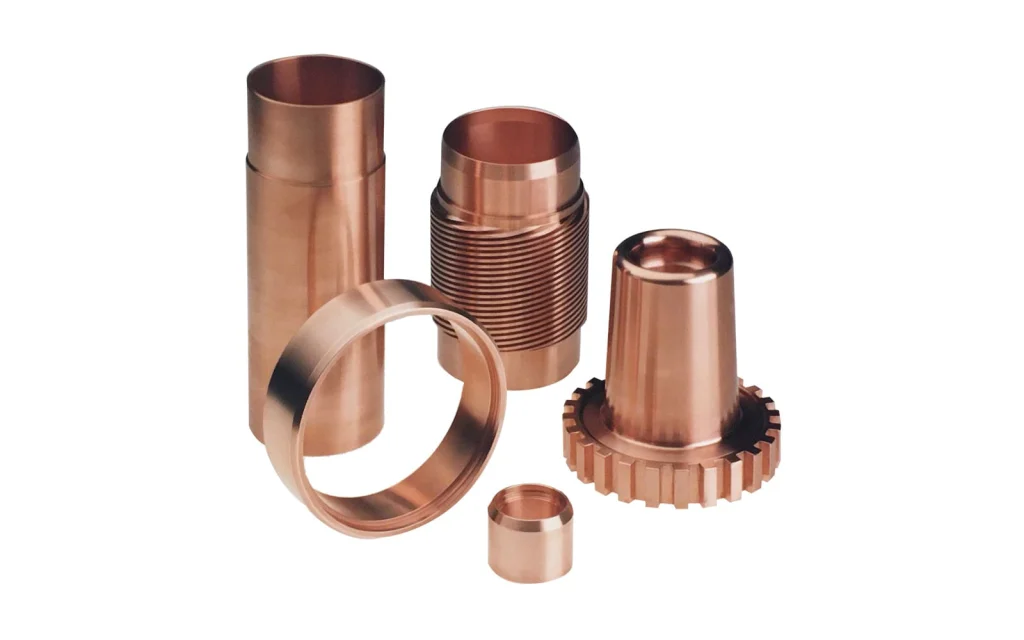
Forgings
Forged to near-net shape
Open-die (free-form) and drop forgings, seamlessly rolled rings and seamlessly forged bushings, plus forged bars, shafts and discs. From individual pieces to large series, in weights up to around 4,000 kg and diameters to 2,500 mm.
- Open-die (free-form) forgings bars, shafts, discs, near-net shapes
- Drop forgings repeatable series work
- Seamlessly rolled rings bearings, flanges, slip rings
- Seamlessly forged bushings bearing and wear components
- Semi-finished products (flat bars, shafts, rod) flat bars, shafts and rod
Castings
A full range of casting processes
A full range of casting processes, matched to the component and the alloy.
Materials
Copper, copper-nickel and beyond
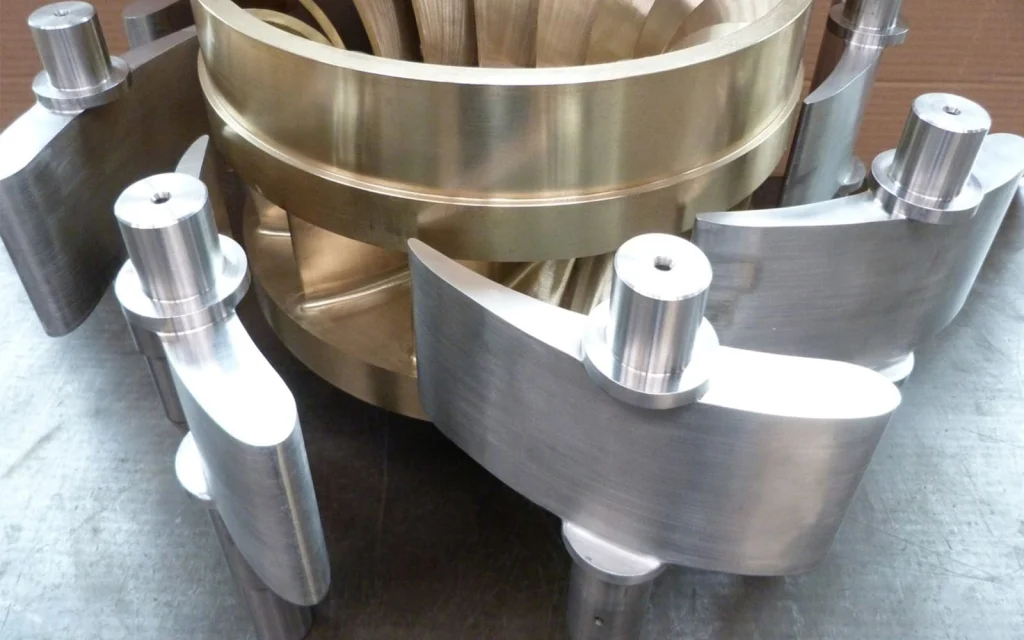
Copper and copper alloys: aluminium bronze (copper-aluminium), copper-zinc, copper-tin-zinc, copper-chromium-zirconium, copper-nickel and copper-nickel-silicon, pure copper and bronzes, including Langley's own Hiduron® and Hidurel® grades. Nickel-based and high-temperature alloys, and steels, where the application demands, with more than 500 alloys available in total.
Applications
Where our castings and forgings go to work
Aerospace, maritime and offshore, defence and naval, power and energy, electrical and electronic, mechanical engineering, cooling technology and furnace construction. From propulsion and subsea equipment to impellers, rings, bushings, rotor components and heat-exchange parts.
Why Langley
One partner, finished parts
We combine mill castings and forgings with our own extensive bar and hollow-bar stock, precision machining and in-house inspection, including ultrasonic testing, to act as a single point of supply. That means finished, fully certified components, delivered reliably even on the most demanding projects.
Material tools
PREN calculator
PREN = %Cr + 3.3 × (%Mo + 0.5 × %W) + 16 × %N. Guidance only; always confirm against the grade's datasheet before specifying.
Sour-service screen (NACE MR0175)
Sour-Service Screen
Work out whether a service is sour from the H2S partial pressure, and see each alloy's NACE MR0175 / ISO 15156 status and hardness limit. A first-pass screen for oil & gas material selection - the full environmental envelope for a grade is set in ISO 15156-3 Annex A.
Candidate grade
| Grade | Family | NACE status | Hardness limit |
|---|
First-pass screen only. This shows whether the service is sour (from H2S partial pressure) and each material group's NACE MR0175 hardness limit and general suitability. It does not reproduce the full environmental windows (maximum H2S partial pressure, temperature, chloride, in-situ pH per grade) - those are in ISO 15156-3 Annex A and must be checked there for the specific grade, product form and condition. Qualification also depends on heat treatment, cold work and welding.
Seawater velocity limits
Seawater Velocity Limits
Check a seawater flow velocity against the maximum design velocity for copper and copper-nickel alloys, to avoid impingement (erosion-corrosion) attack. Enter a velocity directly, or work it out from flow rate and pipe bore. Design guidance from CDA / Nickel Institute and BSMA 18.
| Alloy | UNS | Design velocity | BSMA 18 pipe |
|---|
Design guidance, not a guarantee. Maximum velocities avoid impingement/erosion-corrosion in clean seawater. Limits reduce at small bores (BSMA 18 pipe values apply above ~100 mm bore, reduced below). Local turbulence at bends and fittings, partial blockage, entrained air or sand, and higher temperature all lower the safe velocity. Confirm against the project specification and the product's own data.
Talk to us about your casting or forging requirement
Tell us the grade, form and sizes, and we will do the rest.
Request a quote