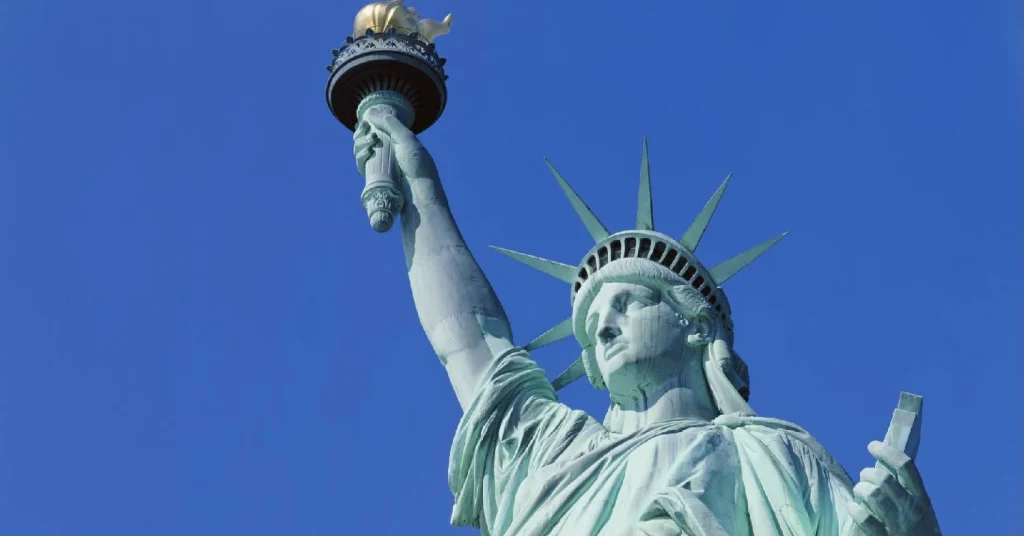
Ferralium® 255 was selected for the flat bar structure and bolting during the refurbishment of the Statue of Liberty, chosen for its minimal galvanic reaction with the copper cladding, its thermal expansion and elasticity close to the original wrought iron, and its far greater strength.
The corrosion problem
The Statue of Liberty is both an iconic structure and a significant engineering challenge. It was built by forming a grid structure against which independent sections of copper cladding were fixed by "saddles", allowing a degree of movement. Failure of these saddles around the torch area resulted from entrapped moisture and galvanic corrosion as water ran down the arm. Shellacked asbestos cloth was originally used between the iron grid and the copper saddles, but over time it dried and became porous. It then absorbed moisture and promoted electrolyte contact and galvanic corrosion. The accelerated corrosion of the iron caused it to swell and distort, which in turn pulled the saddle rivets through the copper skin in many places.
Material selection
The condition and refurbishment of the statue became a national cause. Many companies donated materials and services, including Cabot Haynes, who were producing Ferralium® 255 under licence at that time. The use of Ferralium® 255 followed an in-depth investigation of suitable materials by the National Park Service's North Atlantic Historic Preservation Center. When used for the flat bar structure and associated bolting, it showed minimal reaction with the copper cladding, offered thermal expansion and elasticity similar to the wrought iron, and was far stronger.
Ferralium® 255 was deemed too difficult to shape into the complex forms of the armature bars. The metal selected for them was the extra-low-carbon Alloy 316L stainless steel, which also showed minimal reactivity with the copper and had a modulus of elasticity similar to the wrought iron.