Galling - sometimes called "lock up" - is a key consideration when high-performance alloys are used for valve components in demanding applications. Stainless steels are typically prone to it, a result of the nature of their oxide layer. Super duplex stainless steels resist it far better, which is a major reason for their widespread use in valve trim.
The test method
The standard galling resistance test (ASTM G98) is prone to variability caused by misalignment of test pieces and non-uniform forces across the test surface. It has since been revised to use newly designed annular test specimens that overcome these problems.
The method was originally developed and validated with stainless steels. It has also been used to test super duplex stainless steels and other high-strength alloys, including copper and nickel alloys. Because these alloys resist galling better, the test equipment had to be uprated to accommodate their greater load-carrying capacity and reduced tendency to gall.
Measuring galling resistance
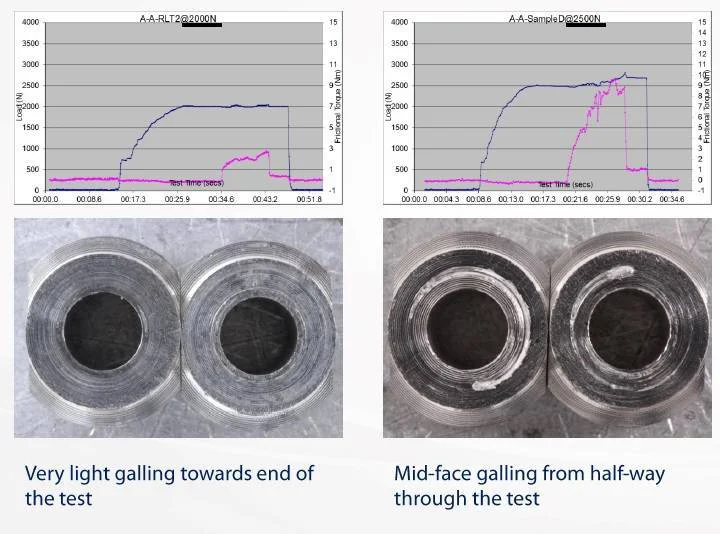
The test determines a Galling50 (G50) value to characterise the relative resistance of materials. This statistical approach identifies the load at which there is a greater than 50% chance of galling. Real-time reporting of sample loads and torque during the test gives further insight into the failure mechanisms.
Few other references to this type of testing exist, reflecting the expensive and time-consuming programme needed to generate a statistically robust body of data. The inherent variability of galling makes that rigour necessary to produce useful results.
Results
Various alloy combinations were tested, including Ferralium® 255-SD50 super duplex stainless steel, both as a self-couple (against itself) and in combination with dissimilar alloys. Super duplex stainless steels gave superior resistance to galling when used in combination, which helps explain their widespread use across valve trim applications, particularly the most demanding. A selection of customer applications illustrates the material selection criteria.