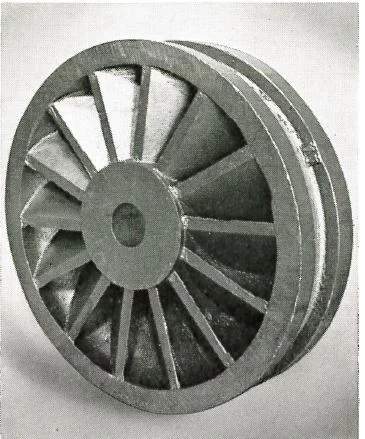
The rotor and sluice gate in a Froude hydraulic dynamometer are cast in Hiduron® 130 bronze to resist the erosion and cavitation that water-braking produces.
William Froude, a colleague and friend of Isambard Kingdom Brunel, invented the hydraulic dynamometer in 1877. Developments of that design remain in constant use worldwide, and have played an essential part in developing practically every type of power unit - proving designs, assessing performance and testing the efficiency of different fuels.
How the dynamometer works
Water provides hydraulic resistance to the rotational input from the motor under test and dissipates the power as heat. The rotor and the sluice gate are the main components of the hydraulic section, and both must survive continuous erosion and cavitation.
Why Hiduron® 130
Hiduron® 130 combines high tensile strength with good ductility and excellent resistance to corrosion and erosion. Its strength and hardness are unimpaired at temperatures of up to 400°C.
The illustration shows a rotor in Hiduron® 130 (DIN 2.1504, DTD900/4805, Hidurax Special) as supplied to Heenan & Froude Ltd., alongside a 'G' type Froude dynamometer.