

The Pitting Resistance Equivalent Number (PREN) is a single figure used to rank the pitting-corrosion resistance of stainless steels and nickel-based alloys. The higher the PREN, the better the alloy resists pitting in aggressive, chloride-rich environments such as seawater or chemical processing plants.
PREN gives engineers and metallurgists a standardised way to compare alloys such as Ferralium® 255 (a super duplex stainless steel) and Alloy 625 (a nickel-chromium alloy) when selecting materials for oil and gas, marine and chemical processing duties.
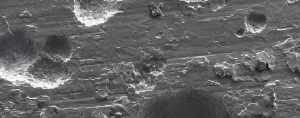
Pitting corrosion is a localised breakdown of the protective oxide layer, driven mainly by chloride ions in environments like seawater, which attack weak points such as defects or scratches. High temperatures, acidic conditions, oxygen depletion and galvanic effects between dissimilar metals all accelerate it, creating small pits that can lead to rapid failure.
How PREN is calculated
PREN weights the key alloying elements that build a protective passive layer: chromium, molybdenum and nitrogen. The most common formula is:
PREN = %Cr + (3.3 × %Mo) + (16 × %N)
- Chromium (Cr): forms the passive oxide layer that protects the metal.
- Molybdenum (Mo): improves resistance to pitting and crevice corrosion, especially in chloride-rich environments.
- Nitrogen (N): stabilises the passive layer and enhances pitting resistance.
A modified version includes tungsten (W) - PREN = %Cr + (3.3 × (%Mo + 0.5 × %W)) + (16 × %N) - but the simpler formula is more widely used.
Calculate PREN for your own composition with our PREN calculator.
The higher the PREN, the better the resistance to pitting. For example:
- Ferralium® 255 (super duplex stainless steel) typically has a PREN around 40, from its high chromium (~25%), molybdenum (~3.5%) and nitrogen (~0.25%) content.
- Alloy 625 (nickel-based alloy) often exceeds a PREN of 45, driven by its high molybdenum (~9%) and chromium (~22%) content.
Why PREN matters
PREN lets engineers match a material to its environment:
- On offshore oil and gas platforms exposed to seawater, alloys with a PREN above 40 are often preferred to resist chloride-induced pitting.
- In chemical processing, where acids and salts are common, high-PREN alloys such as Alloy 625 give longevity and reliability.
- In marine applications, super duplex alloys such as Ferralium® 255 balance high strength with excellent corrosion resistance for components like propeller shafts.
PREN is not the whole story. Temperature, surface finish and other corrosive agents all affect real-world performance, but PREN remains a reliable starting point.
Ferralium® 255 compared with Alloy 625
| Property | Ferralium® 255 | Alloy 625 |
|---|---|---|
| Type | Super duplex stainless steel | Nickel-based alloy |
| PREN | ~40 | Often exceeds 45 |
| Key strengths | Balanced austenite-ferrite microstructure gives excellent strength and corrosion resistance; nitrogen content lifts its PREN, offering robust protection against pitting in chloride environments. | High molybdenum and chromium content make it exceptionally resistant to pitting and crevice corrosion, even in acidic or high-temperature conditions. |
Alloy 625 typically has the higher PREN, but Ferralium® 255 may be preferred where a balance of cost, strength and corrosion resistance is needed. The right choice depends on budget, mechanical requirements and environmental conditions.
Limitations of PREN
- Composition variability: PREN assumes a uniform composition, but real properties vary with manufacturing.
- Environmental factors: it does not account for temperature, pH or other corrosive agents.
- Crevice corrosion: PREN addresses pitting; crevice corrosion in tight spaces needs separate consideration.
Use PREN alongside corrosion testing and field experience to make informed decisions.
Summary
PREN is an essential metric for ranking the pitting resistance of alloys like Ferralium® 255 and Alloy 625. By quantifying the contributions of chromium, molybdenum and nitrogen, it helps engineers select materials that withstand harsh environments. It is not a complete picture of corrosion performance, but it is a vital guide when comparing and specifying alloys.