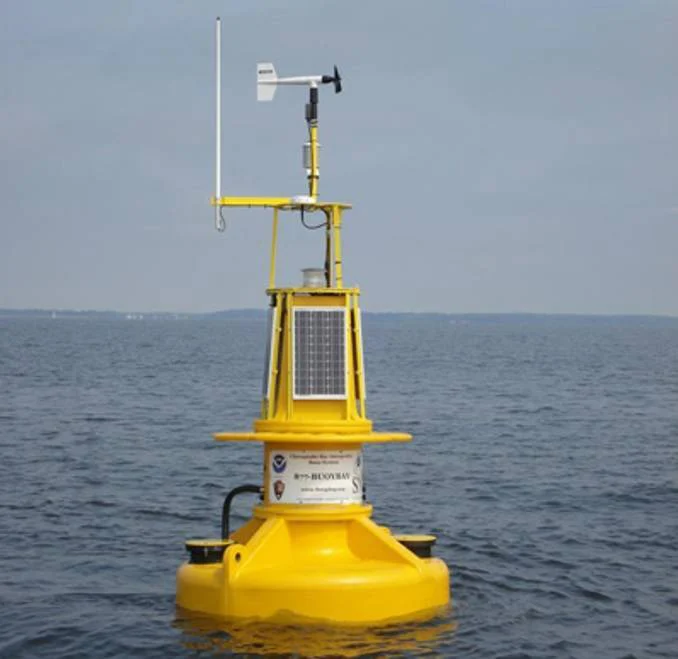

Hiduron® 191 was used for the transducer and sensor housings and the junction boxes of an experimental data buoy, chosen for its seawater corrosion resistance, resistance to marine fouling and good mechanical strength.
Data buoys have been developed over many years to better measure and understand conditions at sea. Like many countries, the UK operates a series of buoys around its coastline that provide near real-time data on variables of interest to meteorologists, maritime shipping and, more recently, developers of offshore renewable energy systems.
The buoys carry a large array of sensors, measuring variables such as:
- current speed
- wind speed and direction
- GPS position
- chemical composition (salinity)
During the initial development of these technologies, Hiduron® 191 was used for the transducer and sensor housings, as well as the junction boxes, for a set of experimental ultrasonic current-measurement and temperature sensors.
Hiduron® 191 was selected for its high corrosion resistance in seawater and its resistance to marine fouling. It combines these properties with good mechanical strength - higher than basic cupronickels - together with the ductility and weldability to allow ready fabrication.
The buoy was initially located 2 miles off the Suffolk coast. After 18 months of operation it was found to be free of corrosion, with only limited fouling that was easy to remove. It was subsequently relocated to a site some 150 miles south-west of Land's End.