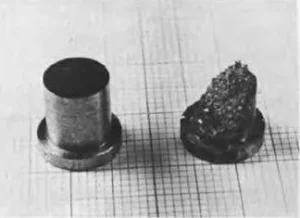
Ferralium® 255 was the first commercially available super duplex stainless steel (SDSS), invented by Langley Alloys and patented in 1967. It has since given excellent service in the most aggressive environments for more than 50 years.
In the years that followed, other duplex stainless steel grades were developed with subtle compositional changes to avoid the original Langley Alloys patent. This family of SDSS is all based around a 25% Cr content, but the grades differ in their copper and tungsten content.
- Ferralium® 255 (S32550, 1.4507, F61) contains approximately 2% copper, which is understood to significantly improve resistance to corrosion in acids such as sulphuric, phosphoric and nitric acid.
- Alloy 32760 (S32760, 1.4501, F55, Zeron 100®) contains up to 1% copper and 1% tungsten. Tungsten is claimed to improve immunity to crevice corrosion.
- Alloy 32750 (S32750, 1.4410, F53, SAF2507) contains no more than 0.5% copper and no deliberate additions of tungsten.
The paper explores the history of these grades, the differences in their composition, the prior art and literature on the influence of copper and tungsten, and the results of recent investigations carried out with the University of Swansea using its leading analytical techniques.
Findings
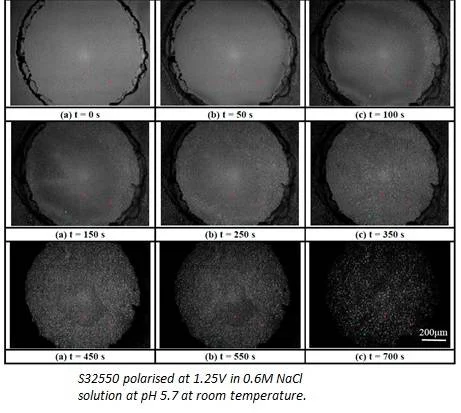
Ferralium® 255 has been shown to provide superior performance in acids, supported by commercially available data from several sources. Potentiodynamic polarisation experiments reveal differences in performance between the three alloys, along with several features worth further investigation. Ferralium® 255 and S32750 were observed to re-passivate more quickly than S32760 at lower temperatures.