What is Stainless Steel ?
Stainless steel is a versatile alloy primarily composed of iron and chromium, with a minimum chromium content of 10.5% that forms a thin, self-healing passive oxide layer on the surface. This layer provides exceptional protection against corrosion, rust, and staining without the need for additional coatings.
Depending on the grade, other elements like nickel, molybdenum, nitrogen, carbon, and titanium may be added to enhance specific properties such as strength, ductility, heat resistance, or wear performance.
Invented in the early 20th century through experimental work by metallurgists like Harry Brearley in Sheffield, UK, stainless steel was initially developed to improve wear resistance for applications like gun barrels. Brearley’s addition of chromium not only boosted durability but also revealed remarkable corrosion resistance during tests with chemical solutions and cutlery.
Today, stainless steel is produced in various forms, including sheets, plates, bars, wire, tubing, and forgings, making it indispensable across industries for its unique combination of strength, corrosion resistance, aesthetic appeal, and longevity.
Types of Stainless Steel
Stainless steels are categorised into several families based on their microstructure and properties:
– Austenitic Stainless Steels: The most common type, featuring a face-centred cubic (FCC) crystal structure. They are non-magnetic, highly ductile, formable, and weldable, with excellent performance across a wide temperature range. They cannot be hardened by heat treatment but can be strengthened via cold working.
– Martensitic Stainless Steels: These have a body-centred tetragonal (BCT) structure, are magnetic, and can be hardened through heat treatment for high strength and hardness, though they offer moderate corrosion resistance.
– Precipitation-Hardening (PH) Stainless Steels: A hybrid type that combines martensitic and austenitic traits, allowing for age-hardening to achieve high strength while maintaining good corrosion resistance.
– Duplex and Super Austenitic Stainless Steels: These offer a balanced microstructure for superior strength and corrosion resistance in harsh environments.
Key Properties
Stainless steel’s appeal lies in its balanced attributes:
– Corrosion Resistance: The passive chromium oxide layer self-repairs in the presence of oxygen, providing inherent protection. Elements like molybdenum boost resistance to pitting, crevice corrosion, and chlorides.
– Strength and Durability: Varies by grade; some offer high tensile strength, while others prioritise toughness or wear resistance.
– Formability and Weldability: Excellent in austenitic grades, allowing complex shapes and easy fabrication.
– Temperature Resistance: Retains properties from cryogenic lows to high heats, ideal for extreme conditions.
– Hygiene and Aesthetics: Non-porous surface resists bacteria, making it suitable for medical and food applications; polished finishes provide a sleek, modern look.
– Sustainability: Fully recyclable with a long service life, reducing environmental impact.
Cold working can increase strength but may reduce ductility and machinability in some grades.
Corrosion Resistance
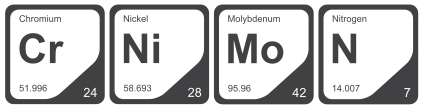
Unlike carbon steels that rely on coatings, stainless steel’s corrosion resistance is intrinsic. Chromium (typically 10.5 to 30%) forms the protective layer, while:
– Nickel improves ductility and resistance to acids.
– Molybdenum (as in 316L and 254) combats localised corrosion in marine or chemical settings.
– Nitrogen (in Fermonic 50 series) boosts strength and pitting resistance.
This makes stainless steel ideal for environments where rust, oxidation, or chemical attack would degrade other materials.
Applications
Stainless steel’s versatility spans consumer, industrial, and specialised sectors:
– Consumer Goods: Cookware, cutlery, appliances, and sinks for hygiene and durability.
– Medical and Pharmaceutical: Surgical instruments, implants, and equipment due to biocompatibility and ease of sterilisation.
– Architecture and Construction: Structural elements in iconic buildings like the Statue of Liberty (New York) and Waterloo Station (London) for strength, flexibility, and weather resistance.
– Industrial and Energy: Pump shafts, valves, storage tanks, and chemical processing equipment to withstand harsh conditions.
– Marine and Offshore: Hydraulic cylinders, couplings, and platforms for superior corrosion resistance in saltwater.
– Automotive and Aerospace: Exhaust systems, fasteners, and components for heat and wear resistance.
– Water Treatment: Pipes and tanks for longevity in corrosive fluids.
In architecture, its combination of strength and formability enable innovative designs, while in medicine, its anti-bacterial properties reduce infection risks.
Further Reading (from our Knowledge Hub):
(?) What is meant by ‘duplex’ Stainless Steel?
(?) Can Stainless Steel be used at low temperatures?
(?) What is the difference between Stainless Steel and Super Duplex Stainless Steel?
(?) What is the melting point of Stainless Steel?
Langley Alloys Supply
At Langley Alloys, we specialise in high-performance stainless steels for critical applications, including couplings, connectors, pump shafts, valve trim, fasteners, sensors, accumulators, hydraulic cylinders, and marine components.
Our stocked grades Fermonic 50 Annealed, Fermonic 50 HS, Fermonic 60, 17-4 PH, 316L, and 254 are available direct, in various forms with full traceability and certifications
For detailed specifications, comparisons, or custom solutions, please contact our Technical Team for expert guidance, or our Sales Team for quotations.


